

AskLuci.io Releases Whitepaper Examining Hidden Administrative Work Costing Allied Health Clinics More Than Money
New insights reveal the impact of fragmented admin systems on financial stress and workforce sustainability.
Gladstone, QLD, Jan. 20, 2026 (GLOBE NEWSWIRE) -- AskLuci.io, an Australian-built operational intelligence company focused on allied health clinics, has released a new whitepaper examining how hidden administrative work is contributing to financial strain, staff fatigue, and long-term sustainability challenges across the sector.

AskLuci.io’s new whitepaper, “The Imminent Disruption in Allied Health Clinics,” examines how invisible administrative workload is driving cashflow pressure, higher operating costs, and burnout across allied health.
The paper challenges the common belief that clinic stress is primarily driven by patient demand or individual effort. Instead, it identifies fragmented administrative systems and unmeasured workflow as a structural issue that quietly increases operational cost, delays cashflow, and places ongoing physical and cognitive strain on clinical and administrative teams.
As part of the research, AskLuci.io identified a previously unmeasured operational indicator — Administrative Minutes per Completed Appointment (AMCA) — which captures the amount of administrative work required to move a single appointment from first contact through to final payment.
According to the findings, AMCA varies widely across clinics and is often significantly higher than owners expect. Tasks such as booking management, billing, claiming, follow-ups, and reconciliation frequently sit across disconnected systems with no clear ownership or visibility, causing administrative effort to compound unnoticed over time.
“Our research showed that clinics often understand their clinical utilisation in detail, but have almost no visibility over the administrative time required to support each appointment,” said Joshua Iaquinto, co-founder of AskLuci.io. “AMCA gives clinics a way to see where administrative effort is accumulating, and why that invisible load has such a direct impact on cashflow and staff wellbeing.”
The whitepaper outlines how elevated AMCA is associated with delayed payments, increased staff strain, and higher burnout risk, even in clinics with strong patient demand. Without visibility of this work, clinics are left managing symptoms rather than addressing underlying system design issues.
“The findings point to a shift in how clinic operations need to be understood,” Iaquinto added. “Sustainable performance depends less on increasing effort and more on designing systems that reduce friction, clarify ownership, and make administrative work measurable.”
The whitepaper provides a framework for understanding AMCA and highlights why operational visibility — not just clinical demand — has become a defining factor in the financial health and workforce sustainability of allied health clinics.
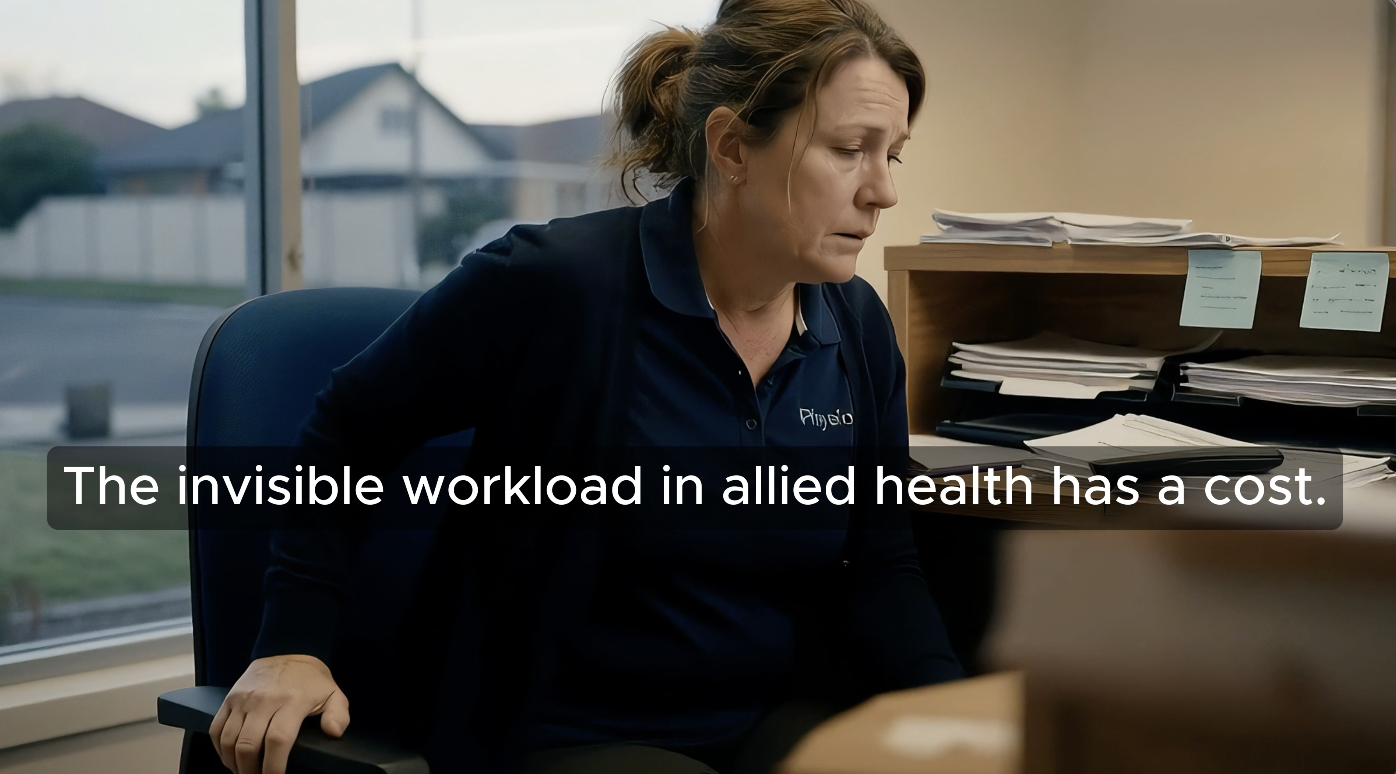
Still from AskLuci.io’s “Invisible Work” campaign, illustrating the hidden administrative load in allied health clinics that contributes to delayed billing and outstanding invoices.
Press Inquiries
Joshua Iaquinto
admin [at] askluci.io
+61468062999
25 Philip Street, South Gladstone QLD 4680 Australia
A video accompanying this announcement is available here: https://youtube.com/watch?v=Oat1w5K8GTs


Legal Disclaimer:
EIN Presswire provides this news content "as is" without warranty of any kind. We do not accept any responsibility or liability for the accuracy, content, images, videos, licenses, completeness, legality, or reliability of the information contained in this article. If you have any complaints or copyright issues related to this article, kindly contact the author above.
